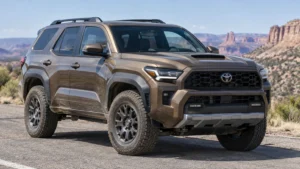
You must now spend at least $45,085 to park a new 2027 Toyota 4Runner in your driveway, marking a historic baseline shift for the rugged nameplate. This price leap forces buyers to evaluate whether standard comfort upgrades balance out reduced factory perks.
The base SR5 now includes standard heated seats and eight-way power adjustment for both front occupants. However, that $1,220 bump also arrives alongside a notable cut to Toyota’s signature complimentary maintenance coverage.
Navigating these higher midsize SUV prices requires looking closely at what your money actually buys before you sign dealership paperwork.
The $45,000 Milestone: Breaking Down the 2027 Price Hike
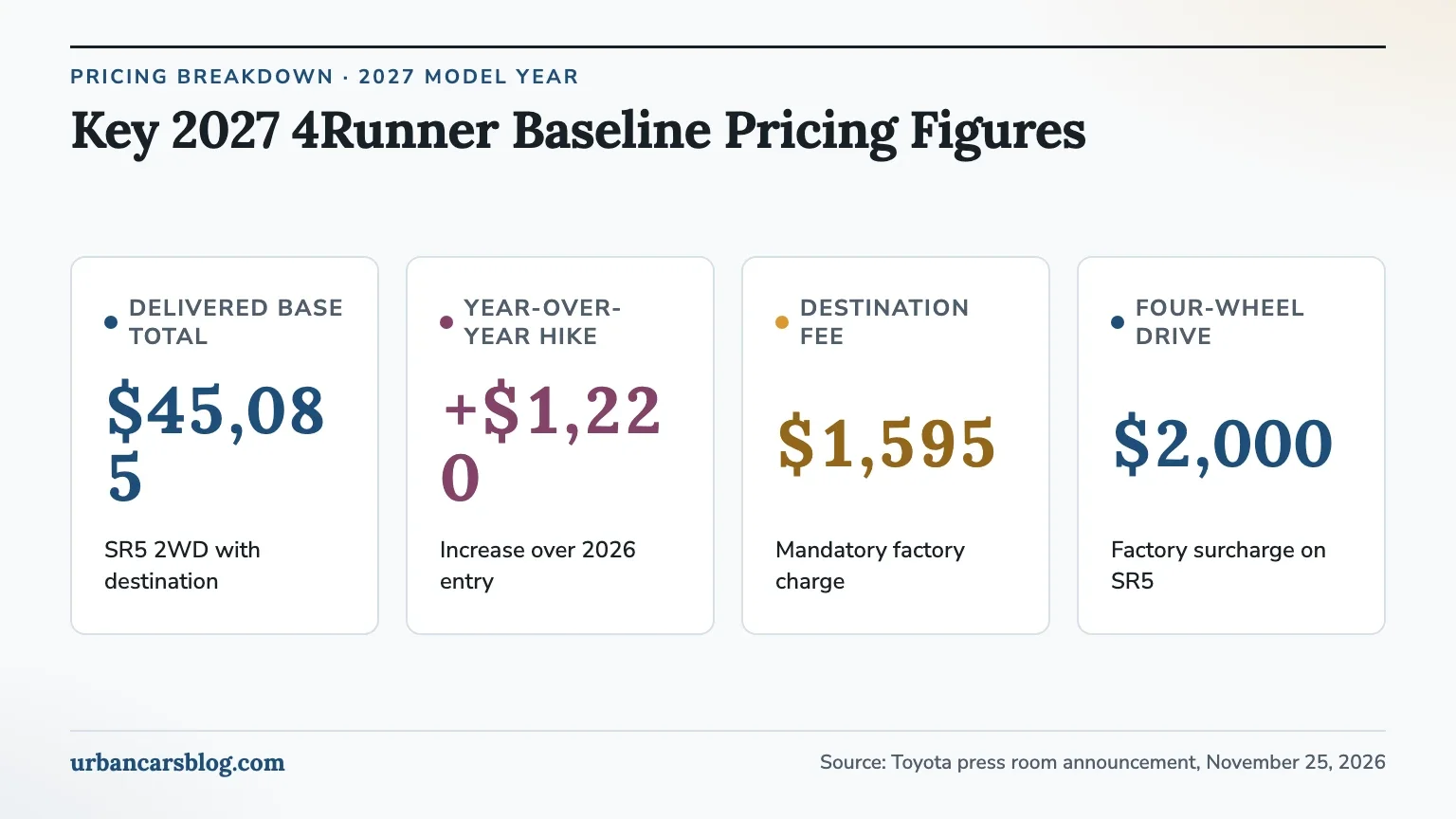
Toyota officially announced pricing details via the Toyota press room on November 25, 2026. The baseline 2027 4Runner SR5 with rear-wheel drive carries a manufacturer MSRP of $43,490 before adding the mandatory $1,595 destination charge.
That total of $45,085 represents a $1,220 increase over the final 2026 SR5 entry price. This adjustment establishes the highest starting barrier to entry in the model’s multi-decade history.
If you want four-wheel drive on entry-level models, budget an additional $2,000. That option pushes a standard four-wheel-drive SR5 to an out-the-door sticker of $47,085 before taxes and dealer documentation.
Mid-tier trims see noticeable price revisions as well. The street-oriented TRD Sport starts at $49,620 MSRP, while the trail-ready TRD Off-Road climbs to $51,560 MSRP; both represent an $870 year-over-year increase.
Premium iterations stretch household budgets even further. Stepping into the TRD Sport Premium demands $54,300 MSRP, and the TRD Off-Road Premium reaches $56,660 MSRP before delivery fees.
Upgrading to the hybrid powertrain on luxury trims elevates figures even higher. The Limited i-FORCE MAX starts at $61,890 MSRP before accounting for taxes, dealer delivery, or lifestyle accessories.
Luxury trims also push toward premium thresholds. The rear-drive Limited starts at $57,090 MSRP, while the upscale Platinum trim commands $64,850 MSRP after receiving a $490 price bump.
Purpose-built off-road flagship grades sit at the very top of the showroom floor. The overland-focused Trailhunter commands $68,590 MSRP, while the dune-running TRD Pro sits at $68,870 MSRP.
Once you factor in the destination fee, an off-road enthusiast will pay $70,465 for a TRD Pro before any port-installed add-ons or regional dealer markups.
Cabin Upgrades Versus Trim Inflation: What Changes Inside
Toyota justifies these higher prices by expanding interior amenities across everyday trims. Every 2027 4Runner now comes equipped with standard heated front seats, eliminating the need to buy cold-weather packages.
Front-seat passengers also gain eight-way power-adjustable seats on the SR5, TRD Sport, and TRD Off-Road grades. Previously, entry buyers settled for manual adjustments on lower trims.
Aside from seating improvements, the core electronic interface remains largely unchanged. The base trim carries over an eight-inch touchscreen running wireless Apple CarPlay and Android Auto.
The standard suite of driver assists continues with Toyota Safety Sense 3.0 across all grades. This system provides adaptive cruise control, lane departure alerts, and automated emergency braking without added cost.
Subtle exterior design revisions differentiate specific grades for the new model year. Toyota renamed its standard black paint option Inked across the entire lineup.
Drivers purchasing the TRD Pro will notice standard red recovery tow hooks mounted to the front bumper. Enthusiasts can also order the TRD Pro in an exclusive Hot Honey exterior hue for an extra $695.
Meanwhile, the range-topping Platinum grade adds distinctive front-door puddle lamps. These ambient projectors illuminate the asphalt with a crisp 4Runner graphic as you approach the vehicle at night.
Powertrain Performance and Urban Fuel Economy Realities
Under the sculpted hood, Toyota retains its modern downsized engine architecture. The standard gas i-FORCE powertrain uses a turbocharged 2.4-liter four-cylinder engine producing 278 horsepower and 317 pound-feet of torque.
Power routes through an eight-speed automatic transmission calibrated for smooth city gear changes. According to manufacturer projections aligned with EPA fuel economy estimates, rear-drive models earn 20 city, 26 highway, and 22 combined mpg.
Four-wheel-drive gas models drop slightly to 19 city, 25 highway, and 21 combined mpg. The Limited four-wheel drive achieves 20 city, 24 highway, and 21 combined mpg.
Urban commuters navigating stop-and-go congestion might favor the electrified i-FORCE MAX hybrid system. Combining the turbocharged engine with an electric motor produces a muscular 326 horsepower and 465 pound-feet of torque.
Hybrid models project ratings of 23 city, 24 highway, and 23 combined mpg. The hybrid TRD Off-Road starts at $54,360 MSRP, while the TRD Off-Road Premium hybrid commands $59,460 MSRP.
Urban planning researcher Dr. Marcus Vance notes that urban SUV owners increasingly expect hybrid torque for tight highway merging. However, he warns that hybrid packaging forces mechanical compromises inside the passenger compartment.
Because the hybrid battery sits under the cargo floor, hybrid grades only seat five passengers. They offer roughly 43 cubic feet of rear cargo room, trailing the gas variant’s 48 cubic feet.
If you need seven-passenger capacity for carpooling, you must choose a gas-only SR5 or Limited trim. Max towing reaches 6,000 pounds on standard setups, dropping slightly to 5,800 pounds on hybrid flagships.
Ownership Costs: The ToyotaCare Cut and Mechanical Longevity
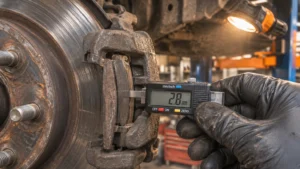
While standard equipment expanded, Toyota quietly reduced its complimentary factory maintenance benefit. The 2027 model year reduces ToyotaCare scheduled maintenance coverage to one year or 10,000 miles.
Previous model years included two years or 25,000 miles of free oil changes and tire rotations. Buyers must now absorb routine second-year service costs out of pocket.
Fortunately, complimentary roadside assistance remains untouched at two years with unlimited mileage. Factory warranties remain dependable: three years or 36,000 miles basic, alongside five years or 60,000 miles powertrain protection.
Hybrid buyers receive eight years or 100,000 miles on hybrid components, alongside a ten-year, 150,000-mile battery warranty. That extensive warranty buffer protects urban drivers against costly long-term electrical repairs.
Urban commuter Sarah Jenkins notes that paying for second-year service changes the total cost calculation. Factoring routine maintenance into monthly leasing budgets ensures no unexpected workshop invoices catch you off guard.
Independent fleet mechanic Dave Miller cautions that turbocharged powertrains demand strict preventative maintenance. Skipping an oil change after free maintenance expires could shorten turbocharger life significantly.
Commuters navigating severe traffic should adhere strictly to factory severe-service schedules. Regular six-month fluid checks preserve valve longevity under high-heat city idling conditions.

Competitive Landscape: Midsize SUV Pricing Pressures
Crossing the $45,000 mark places this truck directly against modern unibody and body-on-frame competitors. Buyers exploring this NHTSA vehicle databases segment face widespread inflation across the entire industry.
Market data published by Kelley Blue Book transaction data on November 10, 2026, revealed that average new-vehicle transaction prices reached an all-time record of $51,109 in October.
Furthermore, midsize SUVs averaged $50,630 in September 2026. Within that macroeconomic backdrop, a $45,085 starting price remains below overall market averages, despite shocking long-time truck loyalists.
Inside Toyota’s own showrooms, the hybrid-only 2027 Land Cruiser starts at $57,880 MSRP before destination. That leaves a distinct price gap for drivers deciding between utility and nostalgic styling.
Domestic rivals also compete aggressively for your monthly payment. The off-road-oriented 2027 Ford Bronco RTR starts at $50,790 MSRP, carrying a hefty $1,995 destination fee.
Meanwhile, family-oriented options like the three-row 2027 Jeep Grand Cherokee L Laredo start lower at $41,730 MSRP. Buyers must choose whether genuine body-on-frame trail capability outweighs daily family comfort.
Negotiating aggressively on dealer documentation fees and avoiding unnecessary distributor add-ons can offset base price hikes. Tracking regional inventory trends allows you to time your dealership visit effectively.
Prioritizing crash protection also influences purchasing decisions. Drivers should cross-reference vehicle evaluations across IIHS safety evaluations to ensure optimal structural defense during metropolitan highway commuting.
Frequently Asked Questions
Why did the starting price cross $45,000 for 2027?
Toyota added standard heated front seats and eight-way power front seats across all trims. A $1,220 MSRP increase and the $1,595 destination fee pushed the base delivered price to $45,085.
Does the 2027 Toyota 4Runner come standard with four-wheel drive?
Rear-wheel drive remains the standard configuration on SR5, TRD Sport, TRD Sport Premium, and Limited grades. Adding part-time four-wheel drive requires a $2,000 factory surcharge on those models.
What changed with the ToyotaCare maintenance program?
Toyota trimmed complimentary factory maintenance from two years or 25,000 miles down to one year or 10,000 miles. Roadside assistance coverage remains active for two full years regardless of mileage.
Can you get a third-row seat in the hybrid 4Runner?
Third-row seating is only available on gas-powered SR5 and Limited models. The i-FORCE MAX hybrid houses an underfloor battery pack that eliminates space for third-row passenger seats.
Future Outlook: Navigating Your Buying Strategy
Dealership allocations began landing at the end of 2026, with widespread lot availability extending through early 2027. Early buyers should prepare for tight inventory allocations on high-demand trims.
If you commute primarily within urban corridors, calculate whether body-on-frame durability matches your actual lifestyle. Independent suspension crossovers deliver superior highway ride comfort alongside substantially higher fuel economy.
However, if you demand genuine trail clearance and proven resale retention, the 4Runner remains an unmatched segment benchmark. Securing an SR5 near MSRP offers capable utility without inflated trim packages.
Keep a close watch on dealer inventory levels during the first quarter of 2027. Patient shoppers can sidestep unnecessary accessory markups by requesting custom orders directly from regional allocation lists.