Monthly auto payments now consume more than a sixth of household earnings in America’s hardest-hit states, forcing drivers to delay routine maintenance. When your car payment strains your paycheck, skipping tire rotations or oil changes quickly leads to expensive roadside failures.
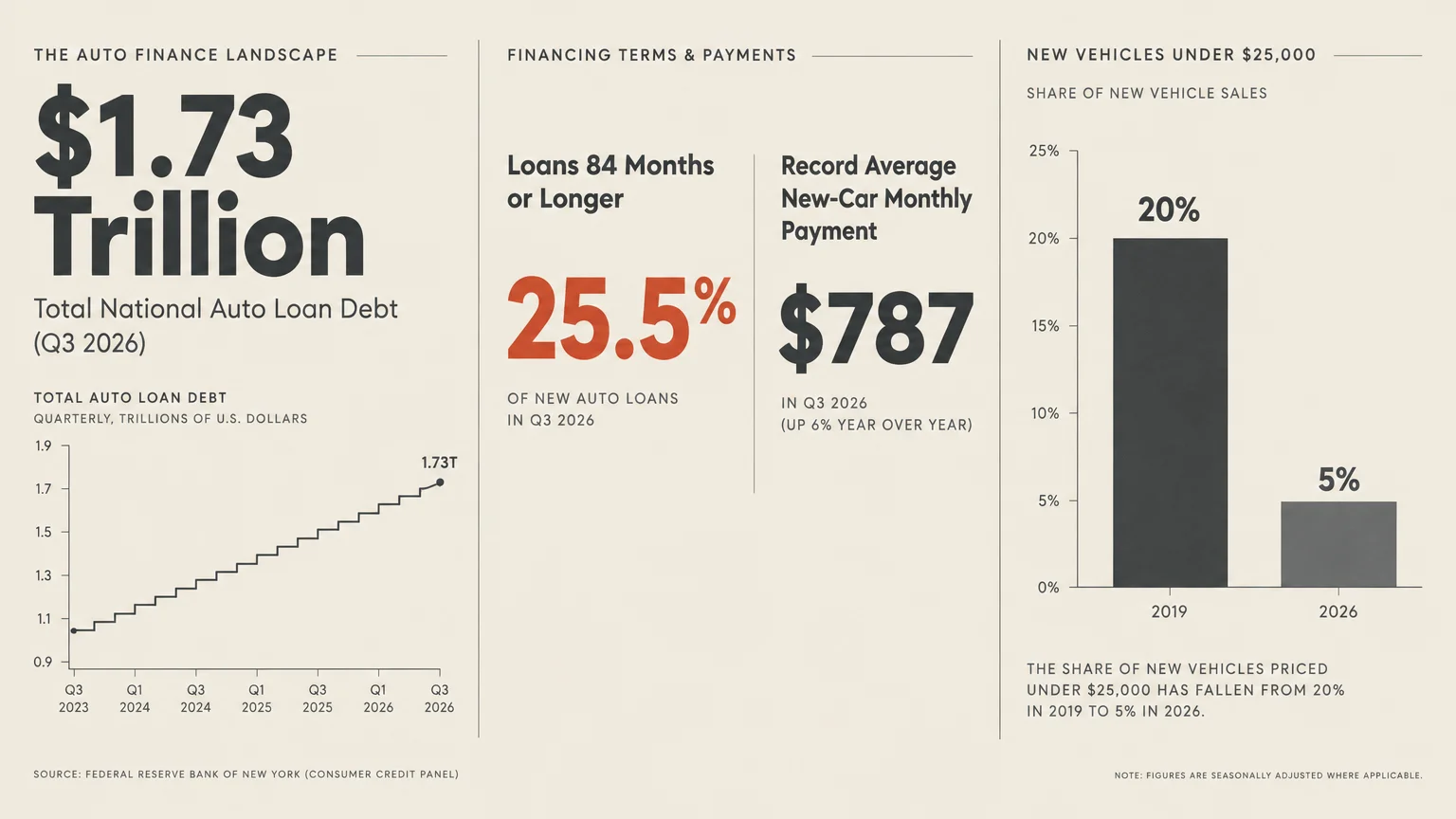
High interest rates, stretched 84-month loan terms, and rising vehicle prices have pushed national auto debt to $1.73 trillion. Drivers across several Southern and Southwestern states carry the heaviest burden relative to local wages.
Examining the five states struggling most exposes the exact financing traps you need to avoid. You can apply these practical strategies right now to trim your payment, keep your vehicle roadworthy, and steer clear of delinquency.
Why Car Affordability Collapsed Across the Country
America’s collective auto loan balance climbed by $21 billion in the third quarter of 2026 to reach $1.73 trillion out of $19.1 trillion in total household debt, according to the Federal Reserve Bank of New York.
New auto loan originations alone hit $208 billion during that single quarter. WalletHub’s analysis of Federal Reserve Bank of New York and Equifax figures shows average household auto debt reached $14,170 in the second quarter of 2026, jumping 55.73% over ten years.
Showroom sticker prices explain why household balances keep climbing. Kelley Blue Book data shows the average new-vehicle transaction price reached $50,562 in September 2026, sitting just $52 below December 2025’s record $50,614.
Affordable entry-level cars have nearly disappeared from dealer lots, leaving city commuters with few budget options. Only 5% of new vehicles sold in 2026 cost under $25,000, down sharply from 20% in 2019.
Popular family segments now demand massive financing commitments even with modest dealer discounts. Kelley Blue Book tracked compact SUVs averaging $37,614 and midsize SUVs reaching $50,630 while incentives covered just 6.6% of transaction prices.
Turning toward pre-owned lots rarely brings meaningful relief for cash-strapped shoppers. Edmunds data shows three-year-old used car prices reached a record $32,461 in the second quarter of 2026, keeping monthly notes painfully high for secondhand buyers.
Experian’s second-quarter 2026 automotive finance report shows buyers financed 83.32% of new vehicles and 37.44% of used vehicles. New-car borrowers averaged $765 monthly on a $43,610 loan carrying a 6.35% APR over 69.5 months.
Borrowing climbed even higher later in the year as shoppers chased larger models. Edmunds tracked third-quarter 2026 new-vehicle buyers financing a record $44,664 on average with a record $787 monthly payment.
Used-car financing brings steeper borrowing costs despite lower purchase prices. Experian’s second-quarter data shows used-vehicle borrowers averaged $542 monthly on $27,852 loans carrying an 11.19% APR over 67.9 months, reflecting an average 688 VantageScore 4.0 compared with 751 for new-car buyers.
To disguise high sticker prices on dealership worksheets, lenders and buyers keep stretching repayment schedules. In the first quarter of 2026, Experian found 35.55% of new-car loans and 31.54% of used-car loans exceeded 72 months.
Ultra-long financing reached a troubling milestone by autumn 2026. Edmunds reported loans lasting 84 months or longer captured an all-time high of 25.5% of financed new-car purchases during the third quarter.
Longer schedules slow equity growth while delinquency rates climb across consumer credit files. Federal Reserve Bank of New York data shows 5.66% of auto loan balances sat 90 or more days delinquent in September 2026, up from 5.02% a year earlier.
That severity sits far above the 3.63% long-term delinquency average, with early transition rates hitting 7.96% in the third quarter. Fitch Ratings also tracked subprime borrowers 60 or more days past due reaching 6.23% in September 2026.
Earlier in January 2026, subprime delinquency touched an all-time record of 6.82% compared with a 3.59% historical norm. Meanwhile, Cox Automotive recorded 1.73 million repossessions in 2024, and industry tracking paced toward 3 million repossession assignments in 2026.
5 States Where Car Loan Payments Hurt the Most
WalletHub’s May 2026 study using TransUnion and U.S. Census figures compared median auto loan debt against median income across every state. While Washington, D.C. posted an auto-debt-to-income ratio of 17%, five states stretched borrowers past 40%.
1. Mississippi: Highest Debt Burden and Heavy Delinquency
Mississippi ranks first for auto overspending, pairing $21,635 in median auto loan debt against just $48,509 in median household income. That 45% debt-to-income ratio stands as the steepest burden in America.
More than 29% of Mississippi residents carry active auto debt, with monthly installments averaging roughly $788 according to WalletHub. ConsumerAffairs and Auto Approve data from June 2026 reveals refinancing applicants there spend 16.8% of reported income on car payments.
Handing over more than one dollar of every six earned leaves virtually no cushion for routine tires, alignments, or brake repairs. Mississippi posted WalletHub’s worst delinquency rate at nearly 3%, while LendingTree’s early 2025 benchmark recorded 9.8% borrower delinquency.
Borrowers in LendingTree’s Mississippi snapshot averaged $802 per month, turning everyday commutes into constant financial fragility. If you drive long stretches across the state, prioritizing modest vehicle reliability over trim upgrades protects both your budget and transportation.
2. New Mexico: Sky-High Balances and Steep Interest Rates
New Mexico places second in WalletHub’s ranking with a 44% ratio, combining $23,437 in median auto debt against $53,752 in median income. That median balance ranks second-highest nationwide, with over 30% of residents holding an open car loan.
Average monthly payments in New Mexico hit $822, squeezing family cash flow across urban and rural corridors alike. Refinancing applicants studied by ConsumerAffairs and Auto Approve carried a $690 median payment and a punishing 14.23% median APR.
Those applicants devoted 16.24% of income to loans stretched across a 75-month median term. Nearly one in six New Mexico refinancing applicants—16.4%—paid $1,000 or more each month for a vehicle.
Per-capita auto debt in New Mexico reached $7,000, sitting 24% above the national norm based on Federal Reserve Bank of New York figures. LendingTree’s March 2026 study also recorded a 4.31% default rate, ranking third-worst nationally against a 1.99% U.S. average.
3. Arkansas: Widespread Borrowing on Tight Household Budgets
Arkansas claims the third spot with a 43% ratio, driven by $21,656 in median auto debt against $50,168 in median income. Over 31% of Arkansas residents carry an active car loan, signaling widespread financing exposure across local households.
Limited public transit outside small metro cores pushes working drivers toward trucks or crossovers even when local wages trail national averages. Arkansas ranked third-highest for auto loan delinquency in WalletHub’s May 2026 dataset at around 2%.
Once loan principal equals more than two-fifths of annual household earnings, rising insurance premiums and fuel costs eliminate spare repair cash. Keeping an older vehicle roadworthy beats rolling remaining balances into a newer showroom purchase.
4. Louisiana: America’s Highest Auto Loan Default Rate
Louisiana ranks fourth in WalletHub’s overspending index with a 42% ratio, reflecting $22,730 in median auto debt against $53,739 in median income. Repayment failure statistics reveal even deeper trouble beneath those headline figures.
LendingTree’s March 2026 credit analysis found Louisiana leads the nation in auto loan defaults at 5.00%, more than double the 1.99% national rate. LendingTree’s Q1 2025 benchmark also showed 8.4% delinquency alongside an $821 average monthly payment.
Refinancing applicants in Louisiana spent 16.75% of reported income on car notes, tied for second-highest nationwide alongside Mississippi and Alabama. Those borrowers faced a $670 median payment, a 13.70% median APR, and a 72-month median loan term.
Like New Mexico, Louisiana tied for second-highest per-capita auto debt at $7,000. Heavy summer heat, rough pavement, and steep flood-zone insurance premiums punish Louisiana drivers who neglect preventive fluid changes or suspension inspections.
5. Oklahoma: High Mileage Demands and Persistent Strain
Oklahoma completes the top five with a 42% ratio, pairing $21,531 in median auto loan debt against $51,576 in median household income. Sprawling highway commutes leave few transit alternatives for daily workers across the state.
Logging heavy annual mileage accelerates wear on tires, wheel bearings, brakes, and transmissions long before multi-year loans end. Without cash reserves for scheduled upkeep, mechanical failures frequently arrive while borrowers still owe thousands on the note.
Regional Pressure Points and Four-Figure Payment Hotspots
Auto affordability stress concentrates overwhelmingly across the Southern United States. ConsumerAffairs and Auto Approve found nine of the ten most car-poor states sit in the South, while Southern states occupied all top 14 delinquency spots in LendingTree’s Q1 2025 report.
West Virginia highlights how stretched schedules disguise payment pain until borrowers fall behind. The state posted America’s second-worst default rate at 4.59% alongside the nation’s longest median refinancing term at 81 months, while Georgia recorded 7.8% delinquency on a $794 average payment.
Four-figure monthly payments have grown shockingly common in pickup-heavy states. LendingTree found 9.6% of U.S. auto borrowers held at least one $1,000-plus payment in the fourth quarter of 2025, consuming 14.0% of the $7,147 median monthly household income.
Texas led the country in four-figure borrowers at 14.9%, followed by Alaska at 13.3% and Wyoming at 12.2%. Texas also posted a 6.1% delinquency rate and America’s highest average monthly car payment at $867—15.5% above the $751 U.S. average.
Among refinancing applicants tracked in June 2026, Alaska and North Dakota tied at 16.5% paying $1,000 or more every month. North Dakota also suffered a 10.81% delinquency surge to 12.62% of tradelines plus a 2.2 percentage-point APR jump to 10.2%.
Balance pressure is now accelerating across several Midwestern and Northeastern states too. Between the first and second quarters of 2026, WalletHub saw Kansas record the sharpest loan balance rise—nearly 2.9% to $20,219—ahead of third-place Maine at over 2.6% to $20,865.
By contrast, stronger local wage ratios and disciplined loan terms protect borrowers in healthier markets. Minnesota posted the lowest default rate at 1.05% and lowest income share spent at 12.2%, ahead of Utah at 1.13% and Massachusetts at 1.20%.
Northeast states also posted the fewest $1,000-plus payments in LendingTree’s fourth-quarter 2025 dataset, led by Rhode Island at 4.4%, Maine at 5.7%, and Pennsylvania at 6.0%. Benchmarking your payment against these regional divides helps spot financial strain early.
Diagnostic Warning Signs That Your Car Loan Is Hurting You
Statewide rankings matter most when you translate them into warning checks for your own driveway. Several clear financial and mechanical symptoms signal that your car note is undermining your stability.
Watch closely as your loan approaches its fourth year, when factory bumper-to-bumper coverage typically ends. LendingTree’s March 2026 default study found defaulted borrowers averaged $540 monthly and commonly defaulted 42 months into a 69-month loan.
Notably, 61.9% of defaulted borrowers held terms of 72 months or longer, while 83.7% carried credit scores below 580. If you accept nonprime financing—averaging $816 monthly over 75.6 months for 601–660 credit scores in Experian’s data—monthly strain intensifies fast.
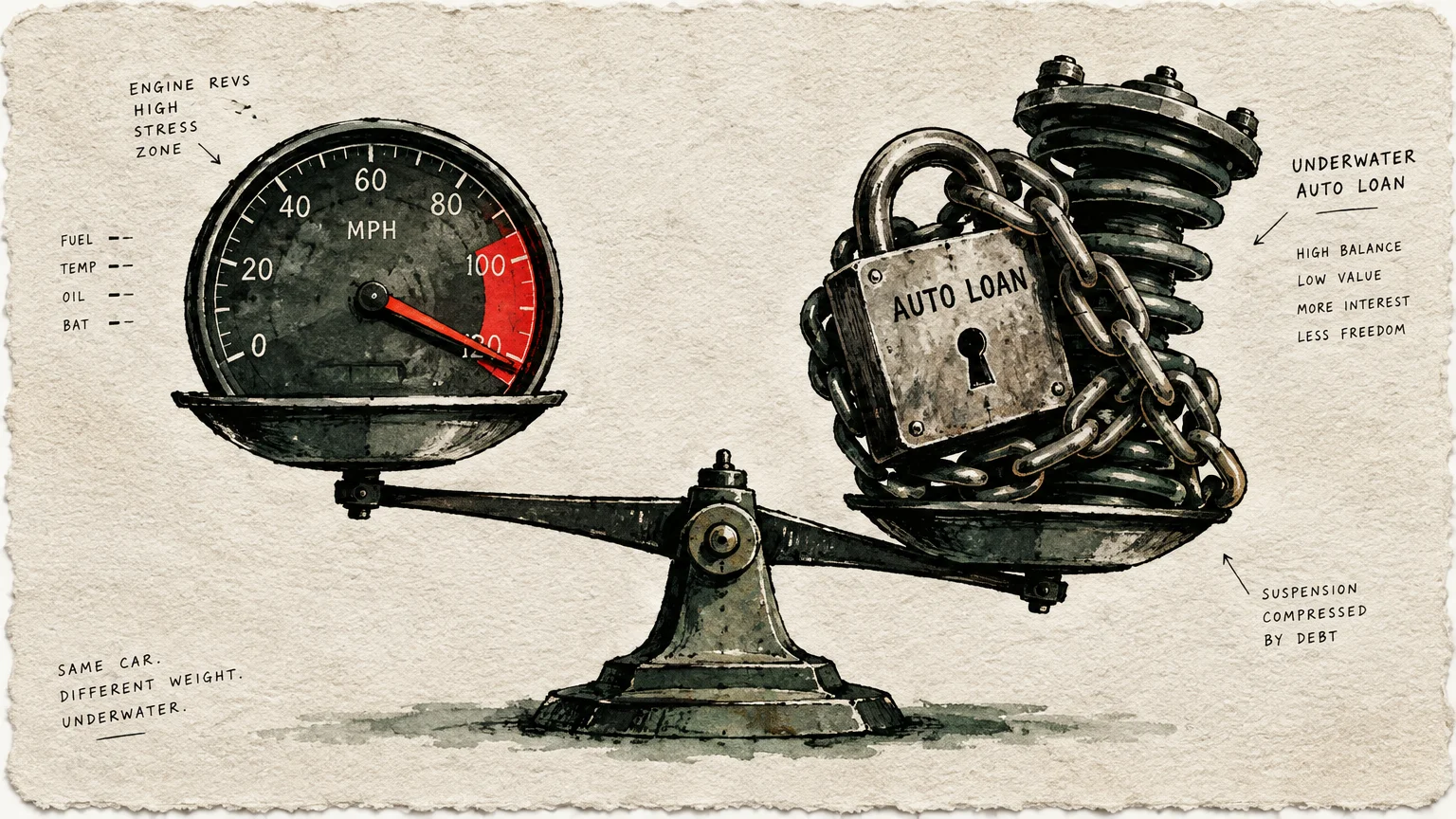
Second, verify whether you currently sit underwater on your vehicle loan. Edmunds reported 29.1% of financed trade-ins toward new cars carried negative equity in the third quarter of 2026, averaging $7,107 owed above vehicle value.
Rolling negative equity into a replacement car magnifies debt risk dramatically. Buyers who rolled underwater balances financed $57,235 on average at an 8.1% APR, paying $952 monthly—$165 above average—while facing $16,610 in lifetime interest and 91.2% taking 72-plus-month terms.
Third, inspect your own maintenance habits for quiet cash-flow warnings. When high loan payments force you to delay oil changes, ignore grinding brakes, or drive on worn tires until payday, your vehicle financing has outgrown your budget.
Dropping comprehensive and collision coverage down to bare state minimums signals another acute hazard. Auto lenders require full physical-damage coverage on financed cars; canceling it often triggers expensive force-placed lender insurance or leaves you paying off a totaled wreck.
Actionable Strategies to Lower Car Debt and Avoid Delinquency
Verify Real Market Value and Refinance Strategically
Check your vehicle’s realistic trade-in and private-party worth on Kelley Blue Book before speaking with any dealership or lender. Knowing whether you hold positive or negative equity prevents you from signing blind loan rollovers.
If your credit score has improved since purchase or you accepted steep dealership financing, shop refinancing rates through local credit unions and community banks. Experian reported drivers who refinanced during the second quarter of 2026 saved an average of $83 monthly.
Confirm your current loan carries no prepayment penalties before submitting refinancing paperwork. Match or shorten your remaining payoff calendar rather than stretching back out to 72 or 84 months simply to lower today’s installment.
Guard Against Hidden Dealership Fees and Add-Ons
Recent regulatory changes place greater responsibility directly on car buyers inside finance offices. On February 12, 2026, the Federal Trade Commission formally withdrew its Combating Auto Retail Scams Rule after federal court rulings vacated it.
Even without that specific rule, the Federal Trade Commission actively polices deceptive vehicle pricing and unauthorized add-ons under federal law. The agency released pricing transparency FAQs on September 15, 2026 and pursued dealership enforcement actions including Asbury Automotive in Texas.
Protect yourself by demanding an itemized, out-the-door price in writing before ever discussing monthly payment targets. Decline optional paint sealants, VIN etching, nitrogen tire fills, or overpriced service contracts that inflate principal and interest charges.
Review official Federal Trade Commission car financing advice alongside Consumer Financial Protection Bureau auto loan worksheets before entering a showroom. Walking in with a preapproved credit union offer shuts down payment-packing tactics immediately.
Contact Your Lender Before Missing a Payment
Waiting until an account hits 60 or 90 days past due strips away your negotiating leverage as repossession assignments accelerate. Federal Reserve Bank of New York figures showed early delinquency transitions reached 7.96% in Q3 2026, proving how rapidly missed cycles compound.
Call your lender’s hardship department the moment an income drop or urgent repair threatens your upcoming due date. Many servicers offer short-term payment deferrals, due-date shifts, or temporary modifications when borrowers reach out before crossing 30 days late.
Document every representative’s name, reference number, and updated payment terms in writing. Following an approved modification plan keeps your vehicle parked safely at home and prevents severe credit score damage.
Downsize Costs Instead of Rolling Negative Equity
Trading an upside-down vehicle for a brand-new SUV almost always deepens your financial hole. Remember that rolling underwater debt pushed average financed totals to $57,235 and monthly installments to $952 in Edmunds’ third-quarter 2026 report.
Keep your existing car maintained and running reliably until extra principal payments erase your negative equity gap. When you eventually replace a vehicle, compare fuel efficiency and annual operating estimates through FuelEconomy.gov before choosing a model.
Selecting an efficient compact sedan or hatchback—even while new cars under $25,000 remain scarce—cuts fuel expenses, insurance premiums, and tire replacement bills at once. Those combined operating savings often rival a full monthly loan reduction.

Preventive Maintenance Habits That Protect Financed Vehicles
Surviving a 69-month, 75-month, or 84-month loan without catastrophic repair bills requires treating preventive upkeep as a non-negotiable monthly bill. Keeping fluids clean and wear parts fresh protects your engine right through the high-risk fourth year when warranties expire.
Follow your owner’s manual severe-service schedule rather than standard intervals if you sit in stop-and-go city traffic or drive in brutal Southern summer heat. Urban idling and short trips degrade engine oil and transmission fluid far faster than steady highway cruising.
Check tire tread depth, sidewall condition, and cold inflation pressures monthly using a reliable pocket gauge. Proper inflation and timely rotations prevent premature shoulder wear, maintain wet-road braking traction, and avoid sudden replacement bills across all four corners.
Have your 12-volt battery, charging system, and coolant hoses tested before extreme summer heat or winter cold snaps arrive. Brutal temperatures in states like Mississippi, Louisiana, New Mexico, Oklahoma, and Texas shorten battery life and stress cooling components right mid-loan.
Inspect brake pad thickness visually whenever your wheels come off for routine tire rotations. Replacing worn pads early preserves expensive rotors and calipers while keeping stopping distances predictable on crowded city streets.
Run your vehicle identification number regularly through the NHTSA safety recall lookup tool. Franchised dealerships complete open safety recall repairs free of charge regardless of your loan status, mileage, or warranty expiration.
Frequently Asked Questions
What digital tools help you track car affordability and loan payoff?
Use free amortization calculators alongside your lender’s mobile portal to monitor how much of every payment lowers principal versus covering interest. Pairing payoff figures with current resale estimates shows the exact month you move from negative equity into positive ownership.
Setting calendar reminders for insurance shopping, registration renewals, and seasonal inspections keeps fixed vehicle expenses visible all year. Tracking total monthly cost of ownership prevents sudden surprises from colliding with your loan due date.
How much does delaying maintenance really cost on a financed car?
Skipping routine oil changes, coolant flushes, or brake pad swaps only saves money temporarily while multiplying mechanical wear. Once metal-on-metal grinding ruins rotors or dirty fluid damages transmission clutches, repair costs jump dramatically above basic preventive service.
A major mechanical breakdown on a financed car creates a severe financial trap because you still owe the full loan balance even while the car sits parked. Building a dedicated monthly repair cushion protects both your mobility and your credit standing.
Which vehicle checks can you DIY versus leaving to a certified technician?
You can safely perform tire pressure checks, wiper blade swaps, engine and cabin air filter changes, washer fluid top-offs, and OBD-II fault code scans at home. These straightforward checks require minimal tools and catch early trouble before small faults escalate.
Leave brake hydraulic work, transmission fluid services, wheel alignments, suspension repairs, and high-voltage hybrid or electric diagnostics to certified technicians with calibrated lifts. Professional inspections spot hidden fluid leaks, worn ball joints, or corroded lines before they fail at highway speeds.
Should you sell an underwater car or keep paying it down?
Selling or trading an underwater vehicle forces you either to pay the $7,107 average negative-equity shortfall in cash or roll that debt into a costlier loan. Continuing to maintain your current vehicle while chipping away at principal usually saves thousands.
Always confirm in your lender portal or in writing that extra payments apply directly toward principal balance rather than advancing future due dates. Direct principal reductions cut daily interest accrual and shorten your path toward debt-free driving.
Take Control of Your Auto Loan and Upkeep Today
High car loan payments do not have to push your household toward delinquency or leave you stranded in an unmaintained vehicle. Whether you commute in Mississippi, New Mexico, Arkansas, Louisiana, Oklahoma, or another high-cost state, clear numbers put control back in your hands.
Pull your current loan statement tonight to compare your APR, remaining months, and exact payoff figure against realistic vehicle market value. Check credit union refinancing options if your rate runs high, and reject padded add-ons on any future dealership visit.
Step outside this weekend to inspect your tire pressures, fluid levels, battery health, and open safety recalls. Pairing disciplined preventive maintenance with a smarter payoff strategy ensures you outlast your car loan and keep your finances moving forward.