Buying a used commuter car during spring or summer often forces you to pay inflated sticker prices on crowded dealer lots. Knowing the best time to buy a used car can easily save you thousands of dollars.
In late 2026, shifting dealer inventory, winter holiday slowdowns, and record new-car prices create clear buying windows for city drivers. You just need to know which weeks bring steep discounts and which months drain your budget.
Follow these data-backed calendar strategies, financing steps, and pre-purchase inspection tips to protect your wallet. You will walk onto the lot prepared to spot real value and close a smarter deal.
Why Timing Dictates Used Car Prices in Late 2026
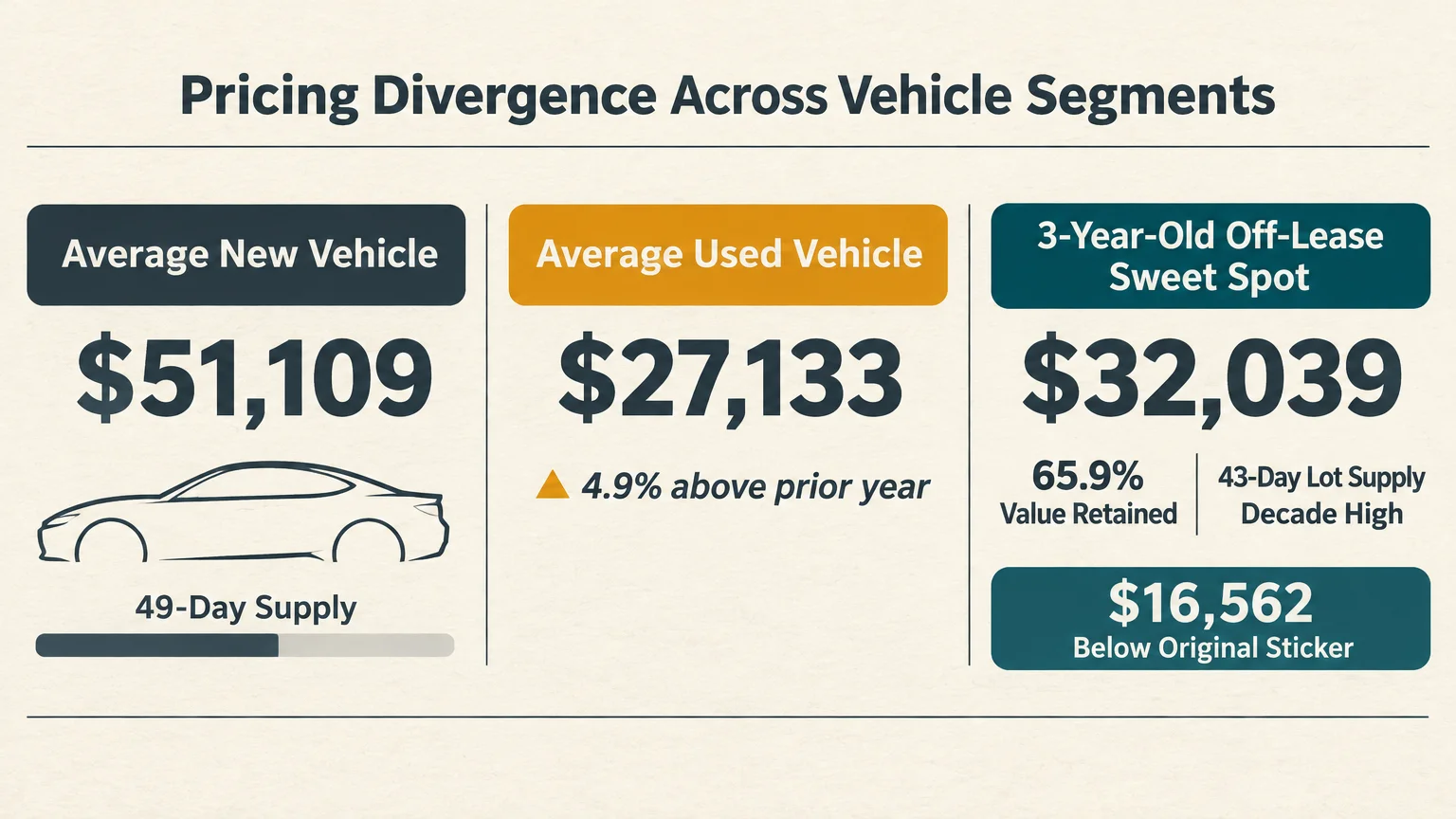
Used car prices remain high by historical standards, so buying at the wrong moment magnifies your costs. In October 2026, dealers listed used vehicles at an average of $27,133, according to Cox Automotive.
That average dipped 0.4% from September ($27,250), yet prices still sat 4.9% higher than in October 2025. Meanwhile, record new-vehicle transaction prices reached $51,109 in October 2026, per Cox Automotive and Kelley Blue Book.
High showroom prices push budget-conscious urban commuters onto used lots, keeping overall demand elevated. Even so, specific market shifts in late 2026 create distinct pockets of leverage if you shop strategically.
The Budget Inventory Squeeze and Three-Year-Old Sweet Spot
Overall U.S. dealer used inventory stood at 2.19 million units in October 2026, representing a 49-day supply per Cox Automotive. However, entry-level vehicles priced under $15,000 fell 19.3% year over year to just a 34-day supply.
Because affordable commuters make up only 15.8% of total inventory, cheap cars sell quickly year-round. You will find far stronger negotiating room on three-year-old off-lease models instead.
In the third quarter of 2026, three-year-old vehicles averaged $32,039, sitting $16,562 below their original $48,601 sticker price per Edmunds. That marks the widest dollar depreciation gap Edmunds has ever recorded, with cars retaining just 65.9% of original value.
Three-year-old cars also lingered on dealer lots for an average of 43 days, hitting a decade high for the third quarter. Longer lot times motivate managers to trim asking prices before year-end carrying costs pile up.
If your current car can safely last a bit longer, supply will improve further next year. Edmunds projects roughly 400,000 more lease returns in 2027 than in 2026, bringing fresher late-model choices to city lots.
Wholesale Trends and Fuel-Price Shifts
Wholesale auction trends often foreshadow retail discounts a few weeks later. Cox Automotive reported that its Manheim Used Vehicle Value Index stood at 206.8 in the first half of November 2026, just 0.7% above a year earlier.
Unadjusted wholesale prices dropped 0.7% from October, outpacing the long-term November average dip of 0.4%. That steeper wholesale slide signals softening values on many dealer lots heading into winter.
Fuel costs also split the market sharply by vehicle size during autumn. AAA data showed gas averaging $3.61 per gallon in mid-November after spiking to $4.41 in early October.
Higher pump prices boosted wholesale demand for compact cars (up 10% year over year) and electric vehicles (up 3.4%), per Cox Automotive. Luxury models, SUVs, and pickups trailed year-ago wholesale levels, giving shoppers better leverage on larger vehicles.
Before narrowing your shortlist, compare city mileage estimates using official fuel economy comparison guides. Balancing purchase discounts against daily fuel expenses prevents a cheap sticker price from becoming an expensive commute.
The Best and Worst Months for Used Car Deals
Seasonal foot traffic drives dealership pricing almost as much as wholesale auctions. When fewer shoppers visit lots, managers rely on markdowns to keep vehicles moving.
Peak Savings: Late Fall Through Mid-Winter
An iSeeCars study of over 42 million used car sales from 2025 through October 2026 identifies November through February as the best months for used car deals. Discounts peak right when winter weather keeps casual browsers indoors.
December ranks first overall, offering 46.2% more deals than average—defined as vehicles priced at least 10% below estimated fair market value. January follows closely with 44.1% more deals than average.
On the study’s average-priced $27,157 used car, landing a 10% deal saves at least $2,716. That kind of winter markdown covers several months of urban parking, insurance, or loan payments.
Edmunds sales data points to October and November as prime territory for transaction discounts, with November taking the top spot. Edmunds Insights Director Ivan Drury notes that year-end new-car promotions lure buyers away from used lots, easing demand.
Pairing late-autumn selection with December and January markdowns gives you strong flexibility. Shoppers who start tracking listings in October and buy between Thanksgiving and late January capture the deepest seasonal price drops.
When to Avoid the Lot: Spring and Summer
The worst stretch for buyers runs from April through September, according to iSeeCars. June stands as the single worst month of the year, offering 28.8% fewer deals than average.
Six of the ten worst times to buy a used car fall in May and June. iSeeCars Executive Analyst Karl Brauer notes that warmer weather and spring tax refunds bring waves of shoppers onto lots, reducing dealer incentives to discount.
Edmunds similarly flags March and April as the most competitive and pricier months on the calendar. When refund checks hit bank accounts, entry-level commuters sell at full asking price within days.
If your car breaks down in spring, consider short-term repairs or transit alternatives rather than rushing into a peak-season loan. Waiting until late autumn often saves far more than a minor spring repair costs.
Holiday Sales, Weekdays, and End-of-Month Myths
Dealership banners promote big savings around every long weekend, yet actual transaction data tells a very different story. Knowing which holidays deliver real discounts keeps you from chasing empty marketing hype.
Winter Holidays Outperform Summer Sales
According to iSeeCars, winter holidays deliver dramatically better used car deals than sunny summer weekends. Martin Luther King Jr. Day leads the entire calendar with 52.7% more deals than average.
New Year’s Eve and New Year’s Day rank second at 48.9% above average, followed by Christmas Eve at 41.2%. Thanksgiving and Black Friday come in at 34.8% more deals, matching Edmunds’ finding that Black Friday is the top holiday for transaction discounts.
Presidents Day (+34.3%), Halloween (+33.2%), and Veterans Day (+32.9%) also beat typical daily averages by wide margins. Cold-weather holidays keep casual buyers at home, leaving motivated sales teams eager to negotiate.
By contrast, warm-weather holiday weekends rank near the bottom for real markdowns. Juneteenth trails the average day by 30.7%, while Memorial Day sits 27.8% below average.
Father’s Day (-26.8%), July 4th (-26.5%), Mother’s Day (-26.3%), and Labor Day (-6.0%) also offer fewer bargains than an ordinary weekday. Skip crowded summer holiday tent events if you want genuine savings.
Choosing the Best Day of the Week
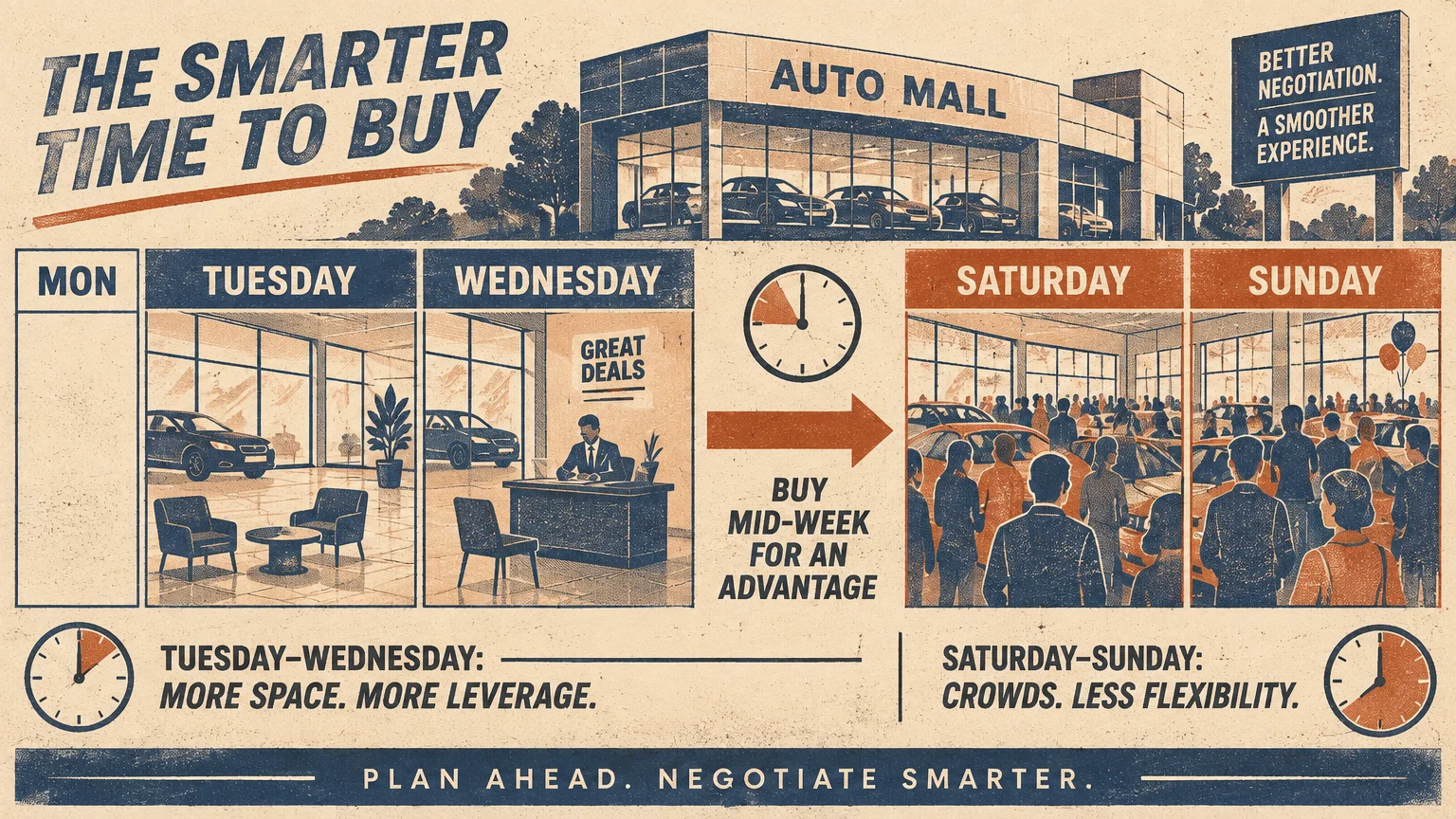
Once you pick the right month, choosing the right day improves your experience on the lot. Edmunds, Kelley Blue Book, and Carfax all recommend visiting on weekdays—especially Mondays or Tuesdays.
Midweek visits mean shorter waits, less crowded test-drive routes, and open bank underwriting desks. You also get more attentive staff who have time to answer questions without rushing you toward the finance office.
Still, do not expect a Tuesday morning visit alone to slash thousands off the price. iSeeCars research found minimal actual price differences between weekdays and weekends on used vehicles.
The same nuance applies to end-of-month shopping strategies. While Carfax notes that monthly and quarterly quotas can occasionally spur discounts, both Edmunds and iSeeCars emphasize that quota pressure matters far less on used cars than new ones.
Manufacturers set volume bonuses primarily around new-vehicle deliveries. Used-car managers care more about how many days a specific vehicle has sat on the lot than what date appears on the wall calendar.

Car Buying Tips for Financing and Credit Prep
Negotiating $2,500 off a car’s price means very little if a steep interest rate quietly eats those savings over five years. In 2026, smart car buying tips start at your bank or credit union before you ever test-drive.
Understanding 2026 Auto Loan Rates and Credit Tiers
Borrowing costs on pre-owned vehicles remain significantly higher than new-car promotional rates. Experian’s second-quarter 2026 finance report places the average used-car loan rate at 11.19% APR, compared with 6.35% for new vehicles.
The average used-car monthly payment reached $542 across an average loan term of 67.86 months. Edmunds reported a nearly identical 11.0% average used-car APR in October 2026.
Your credit score creates massive swings in what you actually pay. Experian VantageScore data from Q2 2026 shows super-prime borrowers (781–850) averaging 6.29% APR, while prime borrowers (661–780) average 8.81%.
Rates jump sharply below prime status, climbing to 13.93% for near-prime buyers (601–660). Subprime borrowers (501–600) average 19.10% APR, and deep-subprime buyers (300–500) face an average 21.62% rate.
At those higher tiers, improving your credit profile by even one bracket before shopping saves thousands in total interest. Paying down revolving credit card balances and disputing report errors two months ahead of winter sales pays off fast.
Locking In Preapproval Before Rate Hikes
Macroeconomic timing matters just as much as dealership timing in late 2026. The Federal Reserve raised its benchmark rate by 0.25 percentage points on September 16, 2026, lifting it to a 3.75%–4.00% range.
After pausing in October, markets widely expect another rate hike at the Federal Reserve’s December 9, 2026 meeting. Rising benchmark rates put direct upward pressure on auto loan APRs heading into early 2027.
Get preapproved by a credit union or online bank before December’s meeting so you lock in a written rate quote. Bankrate advises shopping multiple lenders within a 14-day window so credit bureaus count those inquiries as one without extra score damage.
Walking into a dealership with a firm outside preapproval shifts the entire finance conversation. You give the dealer’s finance manager one clean target to beat rather than letting them mark up your rate.
Keep your loan length as short as your monthly budget allows. NerdWallet recommends capping used-car loan terms at 36 months whenever possible to limit total interest charges.
Checking Electric Vehicle Incentives After Federal Expiration
City drivers eyeing used electric hatchbacks or crossovers need updated tax facts for 2026. Under federal law changes, the Previously Owned Clean Vehicle Credit (IRC Section 25E, once worth up to $4,000) expired for vehicles acquired after September 30, 2025.
Do not factor that expired federal credit into your winter budget calculations. Instead, check your state energy office and local electric utility for active regional used-EV rebates or off-peak charging credits before you buy.
Car Dealership Tips and Consumer Protections
Even during December’s peak discount season, poor paperwork habits can wipe out your savings at the closing desk. Applying disciplined car dealership tips protects you from hidden fees, warranty gaps, and undisclosed vehicle defects.
What Changed With Federal Dealer Rules in 2026
Shoppers often read outdated advice online claiming new federal upfront-pricing bans protect them automatically. In reality, the Federal Trade Commission’s Combating Auto Retail Scams (CARS) Rule never took effect.
The Fifth Circuit vacated the rule on January 27, 2025, and the FTC formally withdrew it effective February 12, 2026. That means you must still guard yourself against surprise documentation fees, nitrogen-filled tires, and unwanted service contracts.
Always request a written out-the-door price by email before visiting the showroom. That itemized total should list the vehicle price, taxes, title, registration, and every dealer fee with zero mysterious add-ons.
Meanwhile, long-standing safeguards under the FTC Used Car Rule (16 CFR Part 455) remain strictly enforced. Dealers selling more than five used vehicles in 12 months face penalties up to $53,088 per violation.
These rules apply nationwide except in Maine and Wisconsin, which enforce similar state-level disclosure laws. You can review your full rights in federal used-car buying protections before visiting any lot.
How to Read the Buyers Guide Window Sticker
Every qualifying used car on a dealer lot must display a Buyers Guide sticker in plain view. If the dealer conducts the sale in Spanish, the law requires a Spanish-language Buyers Guide as well.
Look closely at the warranty section before you fall in love with a car’s paint or infotainment screen. The form clearly states whether the dealer sells the car As Is – No Dealer Warranty, with Implied Warranties Only, or under a dealer warranty.
Under federal law, the Buyers Guide overrides any conflicting language buried inside your final sales contract. If a salesperson promises free repairs verbally, demand that they write those exact terms onto the Buyers Guide and sign it.
Every Buyers Guide also advises you to verify safety recalls, pull a vehicle history report, and obtain an independent pre-purchase inspection. Treat that checklist as mandatory rather than optional.
Weighing Certified Pre-Owned Against Independent Lots
More urban buyers are paying extra for manufacturer-backed coverage in 2026. Certified Pre-Owned (CPO) sales rose 9% year over year in October 2026, capturing 16.4% of total used retail volume per Cox Automotive.
CPO models pass multi-point factory inspections and add manufacturer powertrain or bumper-to-bumper warranty coverage. That extra peace of mind often costs more upfront, yet it pairs well with the steep three-year-old depreciation gap seen in late 2026.
Before selecting any specific year or trim, look up open defects in the federal safety recall database using the 17-character VIN. Unrepaired safety recalls are fixed free by franchised dealerships, and checking upfront confirms whether parts are currently available.
Pair your recall search with independent crash-test safety ratings for your target model year. Older compact commuters sometimes lack modern automatic emergency braking or side-curtain airbags that newer three-year-old models include as standard equipment.
Pre-Purchase Inspections and Seasonal Maintenance Strategy
Winter bargains lose their appeal fast if you buy a neglected commuter car loaded with deferred maintenance. Urban stop-and-go driving punishes brakes, transmissions, cooling systems, and suspension bushings harder than steady highway miles.
What to Check During a Cold-Weather Test Drive
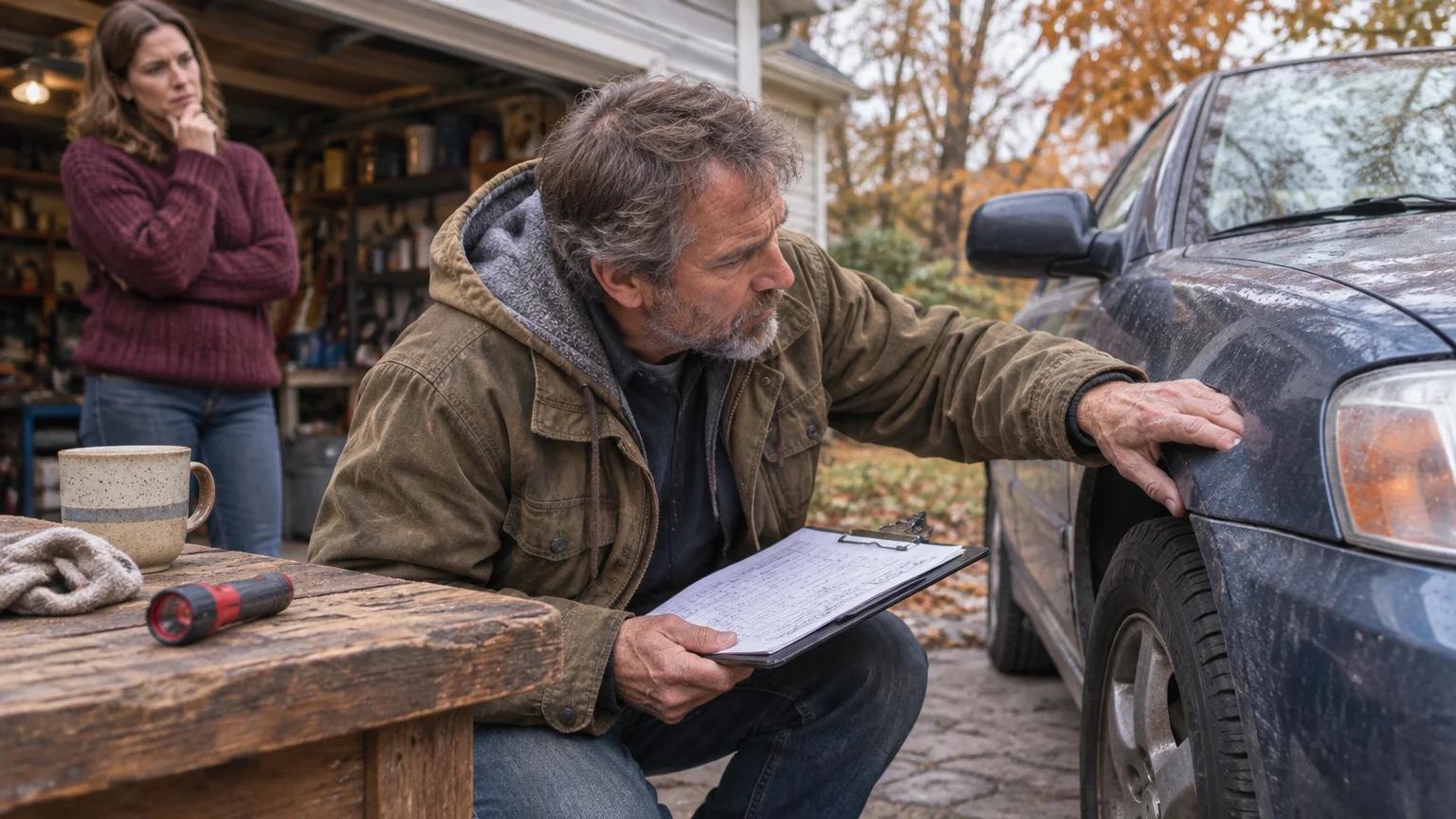
Ask the seller to leave the engine completely cold before you arrive for your appointment. A cold start immediately exposes weak batteries, failing starter motors, noisy timing chains, and rough idle issues that disappear once warmed up.
Turn off the radio and climate fan during the first five minutes of driving. Listen carefully for suspension clunks over potholes, whining wheel bearings, or grinding brakes as you navigate rough city pavement.
Test every interior switch, window regulator, defroster grid, and heated seat while parked. Electrical gremlins caused by water leaks or rodent-chewed wiring harnesses cost hundreds of dollars to trace at an independent repair shop.
Inspect all four tires for uneven shoulder wear, dry-rot cracking, and uniform brand matching. Mismatched budget tires often signal an owner who skipped basic alignment and fluid maintenance too.
Why an Independent Lift Inspection Pays for Itself
Never skip a paid pre-purchase inspection from an independent mechanic, even on a clean three-year-old vehicle. Putting the car on a hydraulic lift reveals bent subframe rails, leaking axle seals, rusted brake lines, and hidden undercarriage flood silt.
Ask the technician to check onboard diagnostic readiness monitors as well. If someone recently cleared a check-engine code to hide an expensive catalytic converter failure, incomplete emissions monitors expose the trick right away.
If your state requires annual emissions or safety inspections, confirm the vehicle meets local compliance standards before money changes hands. A clear mechanical report also gives you factual leverage to negotiate tire or brake deductions off the winter asking price.
Immediate Maintenance Habits for Winter City Driving
Once you bring your car home during peak winter buying season, handle baseline preventive maintenance right away. Follow the factory owner’s manual schedule rather than trusting generic dealership sticker intervals.
Test the 12-volt battery’s cold-cranking strength before freezing temperatures hit your neighborhood. Cold snaps cut battery power sharply, and urban short trips rarely give alternators enough run time for a full recharge.
Adjust cold tire pressures to the exact PSI listed on the driver’s door jamb placard whenever temperatures drop 10 degrees. Underinflated tires lengthen winter braking distances and ruin sidewall tread along city curbs.
Swap streaky wiper blades, top off freeze-rated washer fluid, and keep an emergency kit in the trunk. Reviewing winter vehicle readiness guidelines ensures your newly purchased car handles slush, black ice, and dark evening commutes safely.
Frequently Asked Questions About Buying a Used Car
What DIY inspection tools should you bring to a used car lot?
Bring a bright LED flashlight, a pocket tire tread depth gauge, and a clean paper towel to wipe fluid dipsticks. A basic plug-in OBD-II code scanner also helps spot stored trouble codes or recently reset emissions monitors, provided the seller agrees to the scan.
How much should you budget beyond the sticker price?
Plan on covering state sales tax, title, registration, and dealer documentation fees on top of your negotiated price. Also set aside an immediate maintenance reserve for fluids, wiper blades, or tires, plus interest costs if financing near the 11% market average.
When should you choose a professional mechanic inspection over a DIY check?
Use your DIY walk-around strictly as a quick screening filter to reject obvious problem cars for free. Always hire an independent mechanic with a hydraulic lift before buying any finalist, because structural rust, transmission leaks, and hidden collision repairs are impossible to spot from the curb.
Which digital aids help you verify a used car before visiting the dealer?
Run the VIN through the NHTSA recall lookup tool, pull a full vehicle history report, and check crash-test ratings online before leaving home. Pair those checks with credit union preapproval portals and city fuel-cost calculators to confirm your total monthly ownership budget.

Lock In Your Next Used Car With Confidence
Timing your purchase around late fall and winter holidays immediately puts market odds in your favor. You avoid crowded spring tax-refund bidding wars and capture deeper markdowns on well-equipped three-year-old vehicles.
Check your credit standing this week and lock in a 14-day preapproval window before December’s Federal Reserve meeting. Then shortlist clean, recall-free commuter models, schedule a paid mechanic lift inspection, and drive home with thousands saved.